Monday, June 22, 2009

Little Angels Update

June 2009 Little Angels Trip:

Part of Project Kesho’s work involves supporting a privately run primary school and orphanage near Kampala, Uganda called Little Angels. There are 350 students in kindergarten through 7th grade that attend the school. Of the 350 students, 150 are orphans, and 70 of the orphans live at the school. On the first of June, Elliot, Abbas our Tanzanian friend and Project Kesho staff member, and I boarded a bus from Dar es Salaam bound for Kampala. The bus ride took us about 30 hours of nonstop riding. For the most part the roads have been improved, and we actually managed to get some sleep during the overnight part, unlike the last time we rode the bus.

Since so many of the students at Little Angels are orphans, only about half of the students are required to pay the modest school fee of $10 per three month term. However, most everyone in the village is quite poor and many of the students have trouble paying the modest school fee (there is no public school within walking distance). As a result, Little Angels has trouble meeting their monthly budget, let alone spending money to improve the physical structure of school buildings or to adequately feed and house the orphans who board. Our goals for the trip were to address both their immediate needs as well as their long-term needs.

Rainwater Collection System:

There are two types of water available at Little Angels. There is a slow moving stream located near by and there is also piped water available. Water from the stream has to be boiled, which requires the use of firewood or charcoal that has to be purchased. The water that is piped has to be purchased from the government. Often times when there is not enough money the orphans who are boarding are forced to either drink the dirty water from the stream or go without. Since this part of Uganda has abundant rainfall the leaders of the school asked for a system that would collect rainwater. This simply involves gutters on all the roofs with the runoff collected in large tanks. This way the water can be used immediately or stored for a later date. We also shared with the school leaders our knowledge of using solar radiation to treat water. This is done by putting unsanitary water into clear plastic water bottle and then leaving the bottles in direct sunlight for 6-8 hours. This will allow the school to have clean water even in the dry season.

Beds and Bedding:

The orphanage part of the school lacks enough beds and bedding. Currently the younger children sleep five to a bed and the older children sleep three to a bed. The school leaders requested the purchase of additional beds and bedding. We were able to purchase two additional bunk beds as well as four new mattresses and blankets and bed nets. This will reduce the number of children sleeping per bed as well as providing better mattresses and bedding.

Other Projects:

We purchased food to last a couple months. We hired a local carpenter to repair the roofs and walls of many of the classroom to prevent water from coming in during the rainy season. We purchased general medical supplies for the school to have on hand and we also took several sick children to the hospital and paid for their care. We also purchased a cow and a goat for the school. These animals can be sold at a later date and the money can be used to purchase several additional animals. In the future we hope the school can have many animals that can be used as a sustainable income generating system.

This picture shows the Little Angels School and the surrounding area.

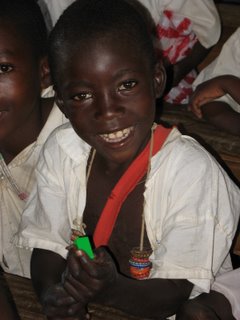
In the above picture are some of the orphans who board at the school. Little Angels provides a safe and loving environment for these children to live in.

This picture shows the water tanks being unloaded from the truck. These tanks will be able to store a combined total of about 400 gallons.

The pictures above and below show children enjoying clean water that was sanitized by solar radiation.

Tuesday, June 09, 2009

Little Angels Update

Elliot, Abbas, and I rode the bus up to Uganda on the 1st of June. We arrived at the Little Angels Orphanage on the 3rd. For the past week or so we have been pricing out options for different projects and talking with the school staff about the best way to spend our money. We have come up with the following budget:

Rain Water Catchment System: We will install gutters and large tanks to collect and store rainwater. This will increase the amount of water the orphanage will have to use, and cut down on their water bill. Along with this project, we passed on our knowledge of how to use solar energy to sanitize water. $400

Beds and Bedding: The children who sleep at the orphanage are currently crammed 5 to a bed. We will be purchasing 2-4 more sets of bunk beds, mattresses, bednets and blankets for the children. $200-$400

Food: We will be purchasing food for the orphanage and school. The tuition fees that are charged are just enough to cover the cost of the teachers each month. Of the 350 students, 150 are orphans (65 sleep at the orphanage). Of the rest of the students, many come from poor families that are often not able to pay the full amount. As a result, most months the teachers only receive part of there salary and the orphans go hungry for days at a time. So we will be leaving behind enough to cover them for a month or so. $200

Animals: The orphanage currently has a cow, a goat and 20 or so chickens. The cow is pregnant and provides a little milk, the goat will be sold soon for money and the chickens provide maybe 5-8 eggs a day. We are going to buy another female cow and possibly some more goats and chickens. Both can be bought cheap when they are young and then sold for double the original price. One goal for the future is for the orphanage to have a steady revenue stream from raising animals to support their own food needs. $200-$300

Health Needs: There are ten orphans who are HIV positive. Uganda just started a free testing program, so soon the rest of the orphans will be getting tested soon. Elliot and I are trying to wade through the Health Care bureaucracy to see if there is an ARV program near the orphanage, as one student is quite sick and several more are on their way to being quite sick. We will also be resupplying their first aid kit. $100

We are about $300-$500 short. Since we are here now and the exchange rate in very favorable (it is 30% better than a year ago) Elliot and I would like to spend as much as we can now. If you feel so inclined a check can be sent to Project Kesho, PO Box 677, Bellevue, WA 98009-0677, or you can donate online. Thanks! Pictures and video will follow when I'm back in Dar next week.

Thursday, May 14, 2009

Spring 2009 Project Update:

During the second half of 2008 Project Kesho focused work in several main areas: facilitating the installation of clean water sources in highly populated areas of the village, continuing our support for the village clinic and working with the primary schools and community members to increase classroom space at both the Lundamatwe and Ulonge schools.

Classrooms:

During the fall of 2008, Project Kesho completed its goal to complete one classroom at each primary school before the new school year started in January 2009. At the Ulonge Primary School we constructed both a classroom and office space for the teachers. This is the third and final teacher's office needed at Ulonge. One classroom at the Lundamatwe Primary School was also constructed. It is a very large classroom so it can be used as a classroom as well as for community meetings and events. Both classrooms have been painted with age-appropriate educational material.

This picture shows the newly completed classroom at the Lundamatwe Primary School. The addition of this classroom has reduced class sizes and provides an additional community meeting space for villagers.

Lundamatwe Primary School students sit in their newly built classroom at desks also furnished by Project Kesho project funds. After this picture was taken, the classroom was also painted with educational murals to enhance student learning.

Clinic:

During the fall and winter of 2008 several changes took place at the village clinic. The doctor for the previous year and a half left the area and went back to medical school. A new doctor replaced him in September but was not paid by the District for his first two months of work. The Kilolo District discontinued its regular medical supply updates that were common during the previous summer. This resulted in the clinic having little more than basic medical supplies during the fall and winter of 2008, and as result the care the village residents received diminished. An under-trained village nurse completed the day-to-day operations due to the doctor’s absence. In November the village endured a large storm that caused part of one side of the clinic roof to collapse. No one was hurt, but the gas-powered refrigerator was ruined, along with the vaccinations inside. The District has not replaced the refrigerator as of March 2009. So the regular vaccinations of children in the Lundamatwe village and the surrounding villages have been discontinued.

Project Kesho has continued to help the clinic through these tough times by giving doctor requested medical supplies on several occasions and by holding village meetings to promote the services offered by the dispensary and the importance of health care in promoting a healthy society. Previously, the residents of the village underutilized the health services of the clinic. During these village meetings, several myths surrounding the clinic were addressed. Villagers were concerned that there were only a few medicines at the clinic and that the doctor was not present on a regular basis. Both of these items were untrue and the villagers left the meetings with a greater understanding of the services available and the doctors availability at the clinic.

This picture depicts the medical clinic near the Lundamatwe Primary School after extensive storms caused major roof and supplies damage. The roof has been repaired, but damage to supplies included a loss of vaccines and operable refrigerator.

Water:

This year Project Kesho facilitated the construction of 5 water projects located in highly populated areas of the village. All five of these projects are short depth wells, three of them have pumps and two are simply bucket drawn wells. All three boreholes with pumps are located near the primary schools, which are the most densely populated areas of the community. One of the other boreholes has been placed near the village dispensary to provide it with a clean and accessible source of water while the other borehole is situated near two roads in a densely populated part of the village, called Lusaula, which is about 2 miles from the center of the village.

The above borehole and attached pump is located near the Lundamatwe Primary School. It provides a second source of clean water for the highly populated region of the village.

The above borehole and pump is located near the Ulonge Primary School. Villagers used to walk over a mile each way to get needed water.

Planned Projects Summer/Fall 2009:

Ulonge Classroom: $6,000 This will be the seventh classroom at the Ulonge Primary School. Constructing this classroom will allow students in the Ulonge community to remain in their home school for education rather than walking the four mile round trip to the Lundamatwe Primary School.

Lundamatwe Classroom: $6,000 The current enrollment at the Lundamatwe Primary School is over a thousand students. This large number of students requires that some grades share a classroom (each receiving instruction for only half a day), while other classrooms have seventy or eighty students in them. The classroom that was built last fall has helped relieved some of the overcrowding and another one built this fall will go even further.

Clean Water Projects: $2,500 The five boreholes that were built last year are currently providing clean water in three populated areas of the Lundamatwe Village. These boreholes are still the only sources of clean water in these communities. Project Kesho has identified five more potential sites that have a surrounding community that is without clean water. Besides installing more boreholes, Project Kesho will be working with community leaders to establish a village-wide Water User Association (WUA). The WUA will provide community members with a voice in how their water is managed and will work within the existing Tanzanian Government’s Rufiji River Basin Management Association.

Clinic Support: $1,000 Project Kesho’s support of the village clinic will continue to be multi-faceted. One method of providing support will be continued provisions for medical supplies. The majority of the money spent last year was on medicine that was used to treat students at the schools who were suffering from various skin and eye infections that are prevalent in the village. This year Project Kesho will be expanding our health outreach to address the needs of those not attending the schools. Project Kesho will also continue advocating for the health needs of these communities through our contacts in the Kilolo District Government.

Community Organization: $3,000 Project Kesho is currently working with residents of the Lundamatwe Village as they organize themselves around several projects. The residents of the village are organizing to address the needs of orphans and vulnerable children (OVC) in their village. OVC's facing many additional hardships, including limited educational success, and are vulnerable to becoming malnourished and sick. A network of residents will help to first identify the OVC's in their communities and then work to address their needs. Secondly, the residents are forming a Water User Association (WUA) to manage the water resource in their communities--this includes the newly dug boreholes. This WUA will work under a national Tanzanian Government framework for managing water.

Stay tuned for a funding update and ways you can help!

Sunday, December 07, 2008

Project Update

The following is an Update from Elliot:
Since my return to Tanzania in October many changes have been happening in the villages and many projects are being completed. The classroom and office at Ulonge Primary School are finished, painted, and ready for windows. The Ulonge borehole near the school is also finished and will provide this part of the village with a clean water source throughout the year. In fact, there is so much water in the Ulonge borehole that when we were pumping out the water to line bricks on the inside of the hole we pumped for two hours straight and still there was over 2 feet of water left in the bottom. We are currently building a borehole in a part of the village called Lusaula, although this project will be a little different because we will not be putting in a pump, only a well to be used with buckets. There is not enough water in Lusaula to support a pump because it is very hilly there. If we were to put a borehole in the lower elevations of Lusaula there would be a lot of water but it would not be clean as this is were many cattle are taken throughout the year to graze and drink. Near the Lundamatwe Primary School, where there are many shops and houses, we are going to construct another borehole as the first one near the school is overused. The classroom construction project at the Lundamatwe Primary School is also coming along well and is ready for a roof. The timeline for the completion of this project is before Christmas so it will be ready for the new school term in January. Work at the farm, which we have named Chogi Farm after a nearby hill, is also proceeding well. Some friends of mine from America came to volunteer and did some work both at the Ulonge borehole and at the farm. At the farm, they helped to complete the fencing and they helped to strengthen and support the roof with longer nails. They also started building the walls around the bathroom. We are hoping to have animals soon at the farm but still need to complete a few things. We did start trying to grow a small amount of broccoli plants, about 150 plants, and they were growing well until mice came and ate all of them. So, we will devise a new way of growing, probably bringing the plants inside every night (they plants are grown in buckets). One sad note in the village is the clinic. Currently the doctor is not coming because the District is not paying him. There is one village worker at the clinic who has minimal training to give shots and dispense some medicine but her skills of diagnosing problems is very limited. Now that it is the rainy season malaria cases are on the rise in the village. The clinic says they get between 20 and 30 cases a week now and medical supplies are dwindling. The District has not re-supplied the clinic for several months. When Project Kesho donated a few supplies last week, the clinic said they have not been re-supplied from the District since before Project Kesho donated supplies at the end of October. The clinic also experienced some structural damage during a recent storm that blew off part of the roof and left a gaping hole, which allowed a lot of water to get inside. The rain not only ruined the drop ceiling but also partially damaged the propane-powered refrigerator. While it still works, the dials have broken and some of the medicine and vaccinations were ruined. It has been several weeks now and the rains are still coming and the District has not yet fixed the problem, but hopefully they will soon. More news to come, Elliot Below is a picture of the new classroom and teacher office space at the Ulonge Primary School. The classroom is painted and ready for the new Standard 6 students in January! This is a picture of the new borehole in the Ulonge Community. The Ulonge School is in the background of the picture. This borehole is the only clean water in this part of the community: This is a picture of the new Lundamatwe classroom. A roof will be put on this coming week, and then it will be painted and completed before the opening of the new school year in January. A second classroom will be built in the Spring of 2009. Once completed, these two new classrooms will go a long way towards alleviating the overcrowding at the Lundamatwe School. This picture shows additional work done to the borehole near the Lundamatwe School. Bricks were added around the top of the borehole to keep water from washing into the top of the borehole. Water collects in this area during the rainy season and we don't want it to wash into the borehole and contaminate the water that is already down in the hole.

Tuesday, October 14, 2008

Updates

Elliot left for Tanzania on Monday. He should be back in the village the following week or so. While he was home, work on our projects continued. Project Updates: Classroom: The classroom at the Ulonge Primary School is almost complete. The walls are up and the roof is on. All that remains is to plaster and paint the walls. Farm: The floor was cemented in preparation for becoming a chicken coop: The farm infrastructure is now complete and Elliot will facilitate the purchase of the animals in early November.

Thursday, September 25, 2008

Orphan Support Program

Project Kesho has been working to support the Orphan and Vulnerable Children (OVC) population at the Ulonge and Lundamatwe Primary Schools since the fall of 2007. The need in both these communities (as well as the rest of East and Southern Africa) is great. *Currently 12 million children in Sub-Saharan Africa are orphaned as a result of HIV/AIDS, and this number is expected to rise in the near future. *The percent of children in Tanzania under the age of 18 who have lost at least one parent to HIV/AIDS is 11%, while in the Iringa Region, where Project Kesho works, the percentage is 16.2%. *More than a quarter of the students attending primary school at either the Ulonge or Lundamatwe Primary Schools are orphans. Last fall we sponsored 35 students to attend secondary school who were unable to pay either because they are orphaned or vulnerable. This year we have been expanding our work to focus on the entire OVC population of the Lundamatwe village (which includes the Ulonge community). This program will consist of three distinct facets. The first will be the identification and training of local village volunteers to conduct home visits. Volunteers will be self-selected and suggested by key community leadership, including church ministers, school officials and council members. Project Kesho’s program associate and program staff member will use their contacts with the school and local churches to recruit willing volunteers, with the Tanzanian staff member serving as the program coordinator. The program coordinator will be responsible for managing the network of volunteers and providing administrative support to the network. Training will be provided to the volunteers. The second facet of this program is the creation of a sustainable animal farm to provide a source of food, education and income for this population of orphans. The goals of this farm will be to supply a sustainable and self-replicating way of providing nutritional support to both the orphans and their foster families and to provide a means for income generation for the orphans and their foster families. The third facet of this program will be to provide for the educational, health, and psychosocial needs of the orphans. The needs will be identified by the network of volunteers. Once the needs of the OVC's are identified they can be brought to the attention of the Program Coordinator and Project Kesho. We will then work to address these needs. The construction of the farm started in early July. The farm consists of building to house chickens and supplies, a fenced area for goats, and another fenced area for growing premium vegetables, which will be sold to local expats. The building to house chickens and supplies is now finished: The following picture shows the farm building under construction: We all pitched in to dig the hole for the bathroom at the farm (yes, this is becoming repetitive, but I think it highlights the lack of sanitary facilities all across Africa). This pictures shows summer volunteer (and all around cool guy) Sam Ziegler doing his share: The following are two pictures of some "helpers" that showed up: To begin to recruit volunteers for the home visiting network, we invited Furaha Dimitry, who is the Chairman of the Executive Committee of African Communities, a network of community-based organizations (CBO's) in Dar es Salaam to conduct a community meeting in Lundamatwe. Over 80 people showed up! Of the 80, 10 people expressed interest in joining a volunteer network to address the needs of the OVC's in their communities. Over the next couple of months we will be holding more meetings in other communities so that the network can be up and running by early 2009. Abbas is currently in Dar, training with Furaha and his CBO so that he can conduct future community meetings. Over 80 people in one classroom! This is Furaha leading the meeting:

Classroom Construction

This fall Project Kesho is facilitating the construction of two new classrooms. We are working with the local communities to construct these classrooms. A deal was struck between the respective communities and Project Kesho detailing how the classrooms would be funded. The respective communities were (and will be for future classrooms) responsible for securing bricks for building (either by making them or purchasing them), gathering large stones that are used for the foundation, and responsible for digging the foundation. Project Kesho is responsible for the rest of the supplies and paying labor for the construction. The local communities are responsible for roughly 15-20% of the construction costs and Project Kesho is responsible for the rest. Community support, either in terms of money or volunteered labor is important because it creates community ownership over the project. The community is able to take pride in its accomplishments and will be more likely in the future to support repairs or upgrades to existing projects. Also, by providing money or volunteering time, the community shows Project Kesho and our donors that they think the project is important to them and they do not view the project as just a handout, but rather a partnership. One classroom is at the Ulonge Primary School, and one is at the Lundamatwe Primary School. The classroom at the Ulonge Primary School also incorporates an attached office for teachers. This gives teachers space to plan lessons and grade papers. This classroom will house the students who are currently in Standard 5 and who will be moving up to Standard 6 in January at the start of the new school year. The construction of the classroom at Ulonge is almost complete. Currently at the Lundamatwe Primary School, students in Standards 1 and 2 share a classroom with one grade coming for a morning session and the other coming in the afternoon. Once this new classroom is completed they can both attend school for a full day. The residents of the Lundamatwe community are currently collecting money and gathering supplies to support their end of the bargain. We anticipate that this classroom will also be completed before the beginning of the new school year in January. The bags of cement needed at the Ulonge Primary School are pictured below. The price of cement has risen almost 25% since this time last year. As the global price of oil has increased it has had a trickle down effect on many parts of the local economy. Transportation costs to bring supplies from Iringa to the construction sites have more than doubled, and the price of lumber has increased because it costs more to bring the lumber to the mills. This pictures shows the trenches that the local community dug for the foundation of the school. The classroom after just a week of construction work. In this picture the office for the teachers is on the left and the classroom is on the right. The rest of the school is on the opposite side of the rooms.