Project Kesho is a non-profit organization dedicated to improving the tomorrows of East African communities through the education of today's children. We work to improve educational access and the quality of educational programs to support East Africans in achieving their future goals. The Project Kesho Blog was designed to provide regular updates to our community supporters about the programs and projects we are currently working on.
**www.projectkesho.org**
For the past couple of weeks Abbas and I have been working to bring clean water to the two communities of Lundamatwe and Ulonge. First we are getting a pump for the borehole by the Ulonge Primary School. Unfortunately the borehole near the Lundamatwe Primary School and the clinic is contaminated, so we have hired local workers to dig a new borehole. The hole needs to be dug down about five or six meters, to the water level, and then lined with bricks and cement. The top of the whole will then be covered and the area readied for the pump. The pictures below show the progress of the two sites:
At the Ulonge Primary School the workers are constructing a base where the pump will sit. The pump does not sit right over the hole, but rather sits off to the side (where the bricks are) with a hose from the pump going down into the hole. See here for one in action.
Near the Lundamatwe School and the health clinic a worker is digging the new borehole:
The health clinic in the village has just received a new refrigerator. The refrigerator can run on either propane or electricity. The doctor told me he should be getting vaccines for tetanus, tuberculosis, measles, polio (not yet eradicated but last reported in the area two years ago), diphtheria, proteases, and hepatitis B. The World Health Organization helps to pay for these vaccines.
The pictures below are of me working at Abbas’ parent’s home in the village taking sunflower seeds out of the flower. This is simply done by hitting the flower with a stick until all the seeds our out. Sunflower seeds are used to make oil, but, like America, children love to snack on them:
Work in Tanzania is progressing very well. The rains have stopped and the weather has cooled considerably. Abbas and I have been meeting with a lot of people to discuss ideas and programs. We have met with the headmasters of the community schools, school boards, and government officials to discuss both their ideas and ours about the concerns surrounding the AIDS orphans in the villages. We have also been discussing the problem of overcrowded classrooms and what to do. Both schools are overcrowded, especially the Lundamatwe Primary School where some classes have close to 90 students per class. The Ulonge Primary School needs a standard 6 classroom for next year (if it does not get one these students will have to go to the Lundamatwe Primary School further exacerbating the problem there). With regional and district governments concentrating their efforts on secondary schools, it is hard for primary schools to receive money to build classrooms.
What the government is funding in the village is the clinic, which recently received a refrigerator, which will run off of propane tanks. I was unable to obtain a picture, as the doctor is in the next town over taking classes, but the nurse explained to us that obtaining the refrigerator is a further step for the maternity ward area of the clinic. The dispensary also needs a refrigerator to store needed medicines to store vaccinations.
Abbas and I have also done more research on a water pump and we think we have found a solution that will work for the village, although one is not enough for a village of this size.
The pump (in the picture) is cheap (under $100), durable, readily available in town (including spares), and can work in borehole less than 7 meters. We photographed this pump in a village on the road to Ruaha National Park, located near tobacco plantations.
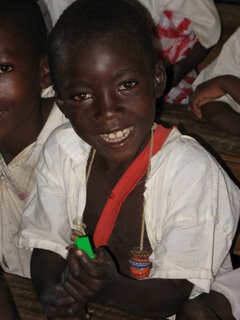
I also attached some pictures of orphans from here in Iringa town. Abbas and I distributed pens, toothbrushes and toothpaste, clothes, and a few pairs of shoes. All the clothes were from my bedroom at my parent’s house from when I cleaned out my dresser in December. It was nice to see other people able to re-use some of my old clothes.
Abbas and I have several plans and projects for the next few months. We will be focusing our efforts in three main interrelated areas. We will be working to address the needs of the orphan and vulnerable children population, supporting primary schools to increase the access and quality of their education, and supporting initiatives to increase the health and wellbeing of these communities.
This is Abbas’s child Ansli with Elliot's glasses:
The following is from Elliot who recently arrived back in Tanzania. Elliot will be working hard for the next couple of months checking in on our past projects, analyzing the current situation, and preparing for our summer group.
The first two weeks working here for Project Kesho have been very interesting. I arrived in Tanzania on April 20th to spend time with my girlfriend before starting work on the first of May. In December I left my motorcycle at her house so that someone could watch it. However, I did not cover it from the rain, so it needed some exterior work done as well as some engine tuning. Abbas met me in Dar es Salaam to help me discuss the repairs with the mechanic, and he helped me transport several of my bags to Iringa. After the repairs were completed, I drove the motorcycle 500 kilometers (a little over 300 miles) to Iringa in one long day.
Since being in Iringa Abbas and I have completed several tasks. The first several days were spent seeing and greeting teachers, headmasters, village leaders, and other people in the village. One of the schools has a new headmaster so we meet with him to explain who are and what we do. We also visited the health clinic, which has received some new maternity equipment. We also had a chance to visit with two of the orphans from primary school we were working with last year. The two orphan boys, Jusef and Nolasco, whom we were working with last year, are still facing many difficulties. They eat once a day (after getting home from school in the evening) and this is after walking 5 miles each way to and from school. One boy had a fungus growing on his scalp (we got him medicine from the dispensary) and he only talks to the other orphan boy who lives with him. Both orphans weighed less than 27 kilos (less than 60 pounds). Abbas and I have been thinking of ways to help, but our extra budget money for orphans is very small. These children need a lot of attention and nutrition to help them lead successful, healthy lives. We are going to visit their home soon, but the road is very bad and it has rained recently, so there will be a small stream to cross. On a lighter note, the rains have, for the most part, stopped and the weather is very nice (a little cool). More news soon…
Here are some pictures that Elliot took upon returning to Lundamatwe:
This first picture is of some of the students Project Kesho sponsored to go to Secondary School. Stay tuned for an update on their status!
This is the new Standard Five classroom at the Ulonge Primary School, which Project Kesho facilitated the construction. Paint and windows are coming soon!
This is an inside shot on the new classroom showing the students hard at work:
Here is the inside of the maternity ward at the Lundamatwe village clinic. This picture shows one of four new beds and the village doctor:
This is Jusef and Nolasco. Jusef is on the left and Nolasco is on the right:
Elliot was no slouch, to say the least, during the Fall of 2007. Some of what he did has been highlighted here and here already, and some has not. The following was written by Elliot (with my commenting in italics):
Uganda:
Following our adventurous trips in getting supplies to finish the Ulonge classroom in Tanzania (again, see here), Abbas and I headed to Uganda to complete another project that would become a much more interesting adventure than we ever hoped or wanted it to be. Our goal, to be completed in just ten days (including 4 and ½ days of travel), was to start building a bathroom at the Little Angels Primary Schooland have the construction far enough along so it could be completed after we left.
We faced several barriers in this project, most notably the main language used in the town we were working in was Luganda, along with with some English proficiency, and the people not being upfront with all information. But, we managed to work through these barriers, and dig the hole for the bathroom. This was a different experience than digging the hole in Tanzania, the ground was quite wet but we had to first cut down a tree, remove the stump, and then remove the roots as dug down (don't worry there is plenty of pictures!!), so each project presents its own unique difficulties. We also had to arrange for all the supplies despite the language barrier. Somehow we had spare time (we were waiting for sand and bricks to be delivered), so we arranged for much needed repairs to desks and classrooms to be completed by the carpenter, with a little help from Abbas and I and the people at the school.
This school is much smaller than the Tanzanian schools we work with and also needs a lot of work. Some students do not even have desks, they merely sit on benches or stumps and when it comes time to write they get down on their knees and write on the ground. For less than $100 we were able to replace or resurface 75% or more of their desks. We simply used the existing desks, some were 2x4s and some were 2x6s, and we purchased 2x12s to be used as the new desk tops. Also included in the $100 were two roofing sheets to cover holes in the roof and sides of the classrooms that were leaking. Many students were getting wet during class as it was (and still is) the rainy season and it rains almost every day. We also purchased food for the school-- two bags of rice and beans.
The picture below will help illustrate transport in Uganda, showing that the motorcycle taxis are not only for people, but for lots of supplies as well.
We were made to feel very welcome by the whole school, they had many songs and dances to perform for us, as well as a great play and I hope to be returning here someday. Although, I am not sure Abbas is as enthusiastic as I am about returning. While he had fun, and was the first person from his family to ever leave Tanzania, he seemed to prefer to speak Swahili and be in Tanzania. He found it hard because since he is black, Ugandans would start speaking Lugandan to him and he would have to explain he was from Tanzania and didn’t speak Lugandan. People would just stare at him and it made him very uncomfortable. I am sure the experience broadened both of us. Although neither of us enjoyed the bus trip back from Kampala to Dar es Salaam. Going to Kampala took a mere 27 hours (it actually wasn’t bad and there were no flat tires and we didn’t run out of gas, like when Elliot and I went in September), but on the return trip our alternator stopped working and we had to spend an extra night at a rest stop. That trip took 42 hours. Neither of us was very happy, but at least we made it safely.
Part of the Welcoming Ceremony:
Even the kids in preschool got into it:
And some really got into it:
Desk Repair:Removing the old desks:
Abbas helping out:
The finished product:
Bathroom Construction:The site for the new bathroom with the tree that needed to be removed:
The digging begins!:
The digging continues and apparently Elliot lost his shoes:
Abbas helping out again (what a sport!):
The tree stumps meets it match!:
Even though the stump is gone there is still a lot of digging to do!:
Elliot in the finished hole (which only took 2 days to dig), and yes, he made it out:
Lundamatwe and Ulonge:
Following my return from Uganda, after two days of recuperation, a friend of mine came from the States to see what my job entailed in Tanzania and help out where he could, and of course go on safari. He also brought with him supplies for the Lundamatwe/Ulonge communities including: supplies to give to the dispensary, shoes and clothes to give away, and two soccer balls, one for each of the primary schools. He also helped as we distributed left over supplies from the summer (that we could not carry over in June) to needy orphans in Iringa (pens, pencils, toothbrushes, toothpaste, and candy).
We had a wonderful time together, we visited Zanzibar for a night, we stayed in a wonderful tented camp (we saw hyenas and lions extremely close and a mother cheetah with two cubs). The roof is now completed on the Ulonge classroom and the carpenters were working on the walls and floor. This week the chalkboard will be installed to have the classroom ready for students, just in time for the new school to start (at the beginning of the calendar year). Enjoy the pictures!
What the finished desks look like:
The new classroom at Ulonge:
The old Ulonge Primary School Sign:
The new Ulonge School Sign (partially funded by Project Kesho):
Village Clinic:
The bare cupboards of the clinic:
Supplies that were donated to Project Kesho for the clinic:
Supplies purchased by Project Kesho for the clinic:
The Village Doctor:
The violence that started with the release of the Kenyan Election Results on December 30th has not stopped. The violence is a mix of those frustrated with the dubious results of the election (for instance, in one precinct, voter turnout was 115%), long simmering tribal tensions between a couple of the larger tribes in Kenya, as well as those joining in the fray just to loot. So far over 600 people have died and 250,000 have fled their homes.
The Kenyan Government has responded by banning public rallies and banning media broadcasts. There has also been numerous reports of Kenyan police and security forces open firing, with live ammunition, on people demonstrating against the election results.
The danger is that this can quickly spiral out of control and scar a generation, as has happened in Rwanda and the Balkans.
Kenya held a general election on the 27th of December. For background on the election go here. The election results were released on the 30th that named the incumbent, Mwai Kibaki, as the winner. There has been widespread rioting against the result and the BBC has reported that over 100 people have been killed so far. For pictures of the elections go here and for a report on a government issued media ban go here.
Reaction from around Africa here.
First Hand News Accounts:
So far I've found one first hand blog account (here), but I'm having a hard time finding more, hopefully they should be coming out over the next week.
You Tube:

 Near the Lundamatwe School and the health clinic a worker is digging the new borehole:

 The health clinic in the village has just received a new refrigerator. The refrigerator can run on either propane or electricity. The doctor told me he should be getting vaccines for tetanus, tuberculosis, measles, polio (not yet eradicated but last reported in the area two years ago), diphtheria, proteases, and hepatitis B. The World Health Organization helps to pay for these vaccines.

 The pictures below are of me working at Abbas’ parent’s home in the village taking sunflower seeds out of the flower. This is simply done by hitting the flower with a stick until all the seeds our out. Sunflower seeds are used to make oil, but, like America, children love to snack on them: